How To Keep Your Cat Entertained
23.04.2026 - Reading time: 5 minutes
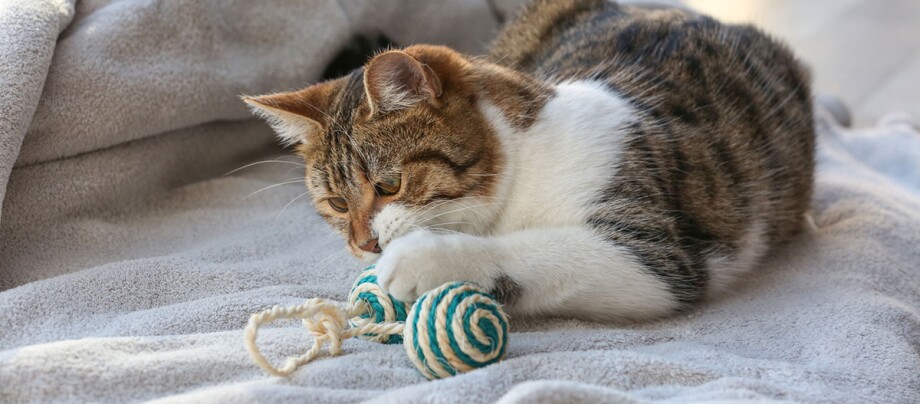
Cats love to sleep - and they sleep a lot! – but when they're awake, they need stimulation to stay physically and mentally fit. If your cat has outdoor access, it can roam, stalk, or climb in nature – this provides welcome variety. Do you have strictly indoor cats? For these feline friends, entertainment at home is especially important. We'll give you tips and tricks on how to keep your cats appropriately occupied – even outdoor cats will appreciate this.
Even the cuddliest cats are instinctively predators. When they play, they’re engaging in activities they need for hunting, fighting, and overcoming obstacles, such as climbing, stalking, and jumping. Outdoor cats can satisfy their natural play and hunting instincts outside and are often less playful indoors. Of course, you enjoy their company, but indoor cats especially need regular, species-appropriate activities to balance their needs. Playing helps maintain their fitness and mental well-being—and strengthens the bond with their favourite humans.
When And For How Long Do Cats Want To Play?
Are you wondering if your cats are occasionally bored or would like more stimulation? Cats often clearly signal that it’s time to play together: This might happen, for example, if your feline friend runs past you, overtakes you, lies down in your path, or demonstratively starts scratching the tree. Some cats will even bring you toys. Calmer cats, however, need more stimulation.
The age of the animals also plays a role in their play behaviour: young animals usually like wild action games, while adult, experienced animals prefer games of skill and intelligence toys for cats .
For older animals, calmer, more relaxed games with their owner are paramount. Even a senior cat should show interest when its human invites it to play – even if it doesn’t necessarily engage.
Observe your pet; when it seems awake and lively, that’s the ideal time for playtime in the living room. For many cats, this is in the evening and early morning. Keep the playtime varied – your cat will show you what it enjoys and how long it wants to play. If it’s had enough, it will simply turn away or even hiss or swat at you. Its playfulness is usually lower immediately after a meal. Important: Never wake sleeping cats – not even to encourage them to play.
What Toys Do Cats Need?
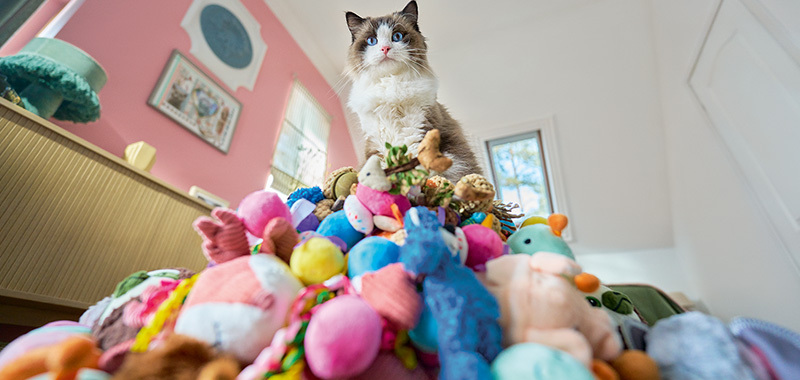
As pet owners, we mean well and can sometimes get carried away with cute toys. If there are constantly too many toys in your cat’s sight, but they aren’t being played with, the overabundance can frustrate and bore them. A better approach: Use a maximum of two different toys at a time and put the rest out of reach. This way, the novelty remains.
Cats generally appreciate variety when it comes to toys. So, offer your feline friend a new toy every now and then. Over time, you’ll see that your cat goes crazy for certain toys, while showing little interest in others. Tip: Find out if your cat is more of an active type or a puzzle-solver, and choose toys accordingly. Explore our full range of cat toys here!
How Do Cats Play?
The play behaviour of young cats serves to teach skills for their later lives as predators. These are movements they need for hunting, fighting, and overcoming obstacles, such as climbing and jumping. Since cats practice these movements throughout their lives, but as well-cared-for house cats are no longer dependent on hunting, they need an outlet for this activity.
A cat’s playful instincts naturally extend to living objects. Cats aren’t exactly gentle with their prey. So, when playing with your cat, it’s not uncommon for them to display more boisterous behaviour and extend her claws. This is perfectly normal. Therefore, avoid playing with your hands, as you could end up with painful scratches and bites. Only if your cat is very gentle and you can easily tolerate a playful swipe of her paw should you use your hand to “sneak up” on her. An old sock or glove can serve as “protective clothing” for your hand.
What Do Cats Play With?
When choosing toys, some cats are picky, while others will play with anything that moves or makes interesting noises. Rustling, crinkling, or squeaking objects are particularly appealing to many felines. Cats generally don’t care whether it’s a special cat toy or a repurposed household item. However, safety is paramount! It’s crucial that the cat cannot swallow the toy or injure itself on it. Tiny bells, smooth marbles, and wool, for example, are strictly off-limits.
Playing with your cat can encourage its natural movements:
- Running and Jumping: With a “lure” like a ball of paper on a string or a slightly heavier cord that can be dragged along the floor, you can encourage your cat to engage in exciting chases around the apartment. Cats also love chasing a rolling ball; however, very few felines are inclined to retrieve the toy. So, if balls and other toys end up under the cupboard, you’ll have to get some exercise yourself.
- Hunting Games: Stalking, pouncing, and catching prey with paws and teeth is also a popular game for cats. You can motivate your feline friend to play exuberantly with toys that allow for distance, such as a cat wand . A cat wand is a string (or alternatively, a wire) attached to a stick, with a small toy made of plush, feathers, or fabric at the end. You can playfully entice your cat with it, and it can chase the “prey.” Let it actually catch and “capture” this prey so it experiences a sense of accomplishment.
- Hide-and-Seek: Cats love to hide and stalk. If there are enough opportunities for this – such as baskets, cat tunnels , and cardboard boxes – or if you hide behind doors and furniture from the cat, a fun game of “find me” quickly develops.
Warning: Never leave your cat alone with toys that have strings attached! The risk of them getting tangled is too great.
Keep It Simple!
With a few simple tricks, you can create fantastic DIY toys and offer your feline friend even more exciting possibilities. For example, take a shallow bowl or a large saucer, fill it with water, and float colorful ping-pong balls or small paper boats in it. Fishing them out isn’t easy and will stimulate your cat’s competitive spirit.
Cats also enjoy hunting for and retrieving food: Hide a treat in front of your cat in a box filled with crumpled newspaper or in a cardboard box with holes of varying sizes all around it. A great activity for the evening: Darken the room and let your cat chase the beam of a flashlight. Don’t forget the reward!