Cats, Milk and Cat Milk
24.06.2026 - Reading time: 5 minutes
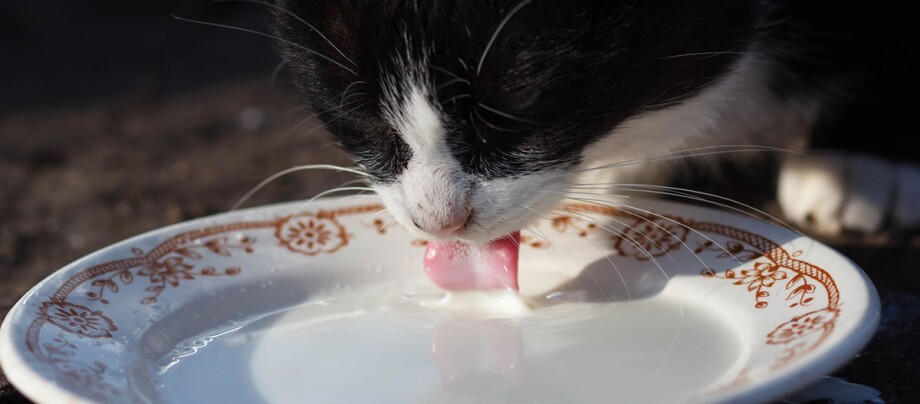
A cat contentedly lapping milk from a bowl – that's an endearing image many people have. The assumption that milk is a food cats love and need has been ingrained for generations. It's also true that a cat will hardly be able to resist a bowl of enticingly fragrant milk. And yet, despite all this, cow's milk is generally not well tolerated by our feline friends.
Can Cats Drink Milk?
Many cats cannot tolerate lactose, the milk sugar found in cow’s milk. Similar to lactose intolerance in humans, consuming milk causes digestive problems such as nausea, diarrhoea, and vomiting. This is all due to physiological reasons: Every newborn mammal depends on its mother’s milk for energy.
The nutritional value of all milk is tailored to the needs of the respective animal species: the faster an animal develops, the more nutrient-dense the milk produced by its mother. To metabolize this milk, the young animal’s stomach produces an enzyme called lactase. This enzyme breaks down lactose, allowing it to be absorbed by the body. During weaning, the body reduces lactase production and eventually stops it altogether. From then on, milk is no longer easily digestible. This is why adult mammals do not drink milk, even if they have the opportunity.
Lactose Intolerance in Animals and Humans – a Historical Connection
Humans are different: Where our ancestors began raising cattle and small ruminants like sheep and goats in prehistoric times, milk was soon recognized as a high-quality, energy-providing food. Over many millennia, the human body developed the heritable ability to digest milk through habituation to it. Only a certain percentage of modern humans have genetic lactose intolerance. In East Asia, where dairy farming historically played a negligible role, it is far more common. This clearly indicates that the ability to digest milk in adulthood stems from an interaction between cultural development and heredity.
But back to the cats…
…and their culinary preference for milk. Humans also play a role here. Domesticated cats were indispensable companions as mousers, especially in rural areas. Farms usually also kept cows, which were, of course, milked. The availability of milk, the knowledge of its healthy nutritional value, and the presence of cats led to well-meaning people occasionally offering it to the animals. And indeed: So-called “farm cats,” accustomed to milk from a young age, developed a certain lactose tolerance, similar to that in humans, which can be passed on to their offspring.
However, our feline companions today generally no longer grow up on dairy farms, and lactose tolerance is not widespread across the species. For you as a cat owner, this means that even if your cat were lactose tolerant, you shouldn’t experiment for the animal’s sake. Assume that milk is not suitable for your cat and can cause other problems besides stomach aches.
How About Lactose-free Milk for Cats?
The bigger problem is lactose. A seemingly obvious solution is to simply give your cat lactose-free milk. But that’s not ideal either, and here we need to look at mother’s milk, the species’ natural milk. A calf, for which cow’s milk is intended, is on its feet shortly after birth and must be able to escape predators if necessary. This requires a lot of energy from the high-fat milk. Cats, on the other hand, are altricial after birth and have a much more economical energy consumption. Accordingly, cat milk is lower in fat. Lactose-free milk would therefore probably be digestible for the cat, but a veritable calorie bomb that is detrimental to the animal’s health.
Why is Milk Taboo, but Cheese isn't?
Equally high in calories, but established as cat snacks and very popular with felines, are processed dairy products. These are a good source of protein and can be given in moderation as treats. With cheese, the ripening process of hard cheeses almost completely eliminates the lactose. Parmesan and similar varieties no longer pose this risk. The chemical composition of dairy products fermented by bacteria also changes. As a general rule of thumb, cats should be treat with only small portions of these dairy products, such as a fingernail-sized piece of hard cheese or a spoonful of cottage cheese. The amount of lactose ingested with such small portions is so minimal that it generally does not cause any problems for the cat.
By the way: Since dairy products have a high salt and phosphate content, your cat should not be given cheese if they suffer from kidney disease.
What Exactly is Cat Milk?
Is your purring feline gourmet a big milk fan despite all the challenges? Your cat doesn’t have to go without entirely. Pet stores offer a specially designed solution: cat milk. This special milk is lactose-reduced, tailored to a cat’s nutritional needs, and, what makes it particularly interesting as a dietary supplement, is that it’s usually enriched with taurine, an aminosulfonic acid essential for a cat’s health. Cat milk also provides an extra dose of vitamins and calcium, making it a valuable supplement for pregnant, lactating, or otherwise weakened or stressed cats.
Please note: Cat milk is not a drink.
There is nothing wrong with occasionally giving your cat a bowl of cat milk as a treat, but the milk does not replace drinking water.
Explore Maxi Zoo’s selection of cat milk and drinks here.