Guinea Pig Care – Ensuring Species-Appropriate Conditions
23.07.2026 - Reading time: 12 minutes
Aul Zitzke / stock.adobe.com
To ensure your new housemates feel truly at home, you should consider a few important things before they move in and thoroughly inform yourself about the proper care of guinea pigs. After all, even though these small rodents may seem undemanding at first, they have specific needs that you, as their owner, must meet.
- Where do guinea pigs come from?
- Natural habitat as a model for species-appropriate care
- The more members of the same species, the better
- Keeping dwarf rabbits and guinea pigs together?
- Can I keep my guinea pig alone?
- What do I need to consider when keeping guinea pigs?
- Keeping Guinea Pigs: Indoors or Outdoors?
- Further tips on keeping guinea pigs
- Socialising guinea pigs
- Are guinea pigs suitable for children?
- Guinea pigs – the ideal pets?
Where do guinea pigs come from?
Guinea pigs originate from South America. A local legend holds that these small rodents were domesticated by the indigenous peoples of the Andes. In their native habitat, wild guinea pigs live in large groups on relatively barren land; consequently, they cover long distances in search of food. To hide, they dig and utilize burrows and underground tunnels.
Natural habitat as a model for species-appropriate care
The natural habitat and lifestyle of wild guinea pigs serve as a model for species-appropriate care. From this, the two most important principles of keeping guinea pigs in a species-appropriate manner can be derived:
- Guinea pigs must never be kept alone.
- Guinea pigs require plenty of space to roam.
Furthermore, a look at their South American origins reveals that:
- Guinea pigs are adapted to a relatively sparse diet.
- These small rodents are skilled at digging.
- Guinea pigs are capable climbers.
The more members of the same species, the better
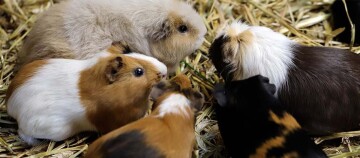
Guinea pigs are happiest in a group of four to five animals. Two animals will suffice in a pinch—but a guinea pig should never live alone, nor does it want to.
All-female groups or a “harem” setup work very well: you can house your females with a male, provided he is neutered. Keeping multiple males is more challenging due to the territorial rivalry involved, though not impossible. Success depends on the size of the enclosure, the animals’ ages, and their personalities.
Keeping dwarf rabbits and guinea pigs together?
You should under no circumstances heed the well-intentioned but completely wrong advice to house a guinea pig with a rabbit. A dwarf rabbit is no substitute for a proper guinea pig companion. Pairing a guinea pig with a dwarf rabbit—a practice still frequently seen—is not appropriate for the animals’ needs. Ideally, there should always be at least two animals of the same species.
In the wild, however, these two species have no interaction and speak different “languages.” Because dwarf rabbits and guinea pigs generally exhibit such different behaviors, housing them together should only be attempted in very spacious, well-planned enclosures and with an emergency plan for separating them. If a solitary dwarf rabbit and a solitary guinea pig appear to get along well, it is simply because they have no other options. This is much like a solitary guinea pig becoming particularly trusting only because it lacks social contact with others of its own kind. Such an arrangement, however, is incompatible with species-appropriate care.
Can I keep my guinea pig alone?
Keeping guinea pigs can become problematic if one of the pair dies. A young guinea pig is often not a suitable match, especially if the surviving animal is already somewhat older. If you do not want to leave the remaining companion alone but also do not wish to buy a new guinea pig, consider contacting a local guinea pig enthusiast group: many offer “loaner” guinea pigs to keep your pet company. You can return this animal later or keep it permanently alongside a new partner. In the long run, even an older guinea pig left behind after the loss of a companion should not have to live alone.
What do I need to consider when keeping guinea pigs?
Ideally, you should provide your guinea pigs with a habitat that mimics their natural environment: a large enclosure featuring plenty of hiding spots and opportunities for enrichment. For a group of five to ten animals, plan for a minimum area of six square meters; this is the recommendation of the TVT (Veterinary Association for Animal Welfare). It is even better to allocate one square meter per animal—meaning ten square meters for ten animals.
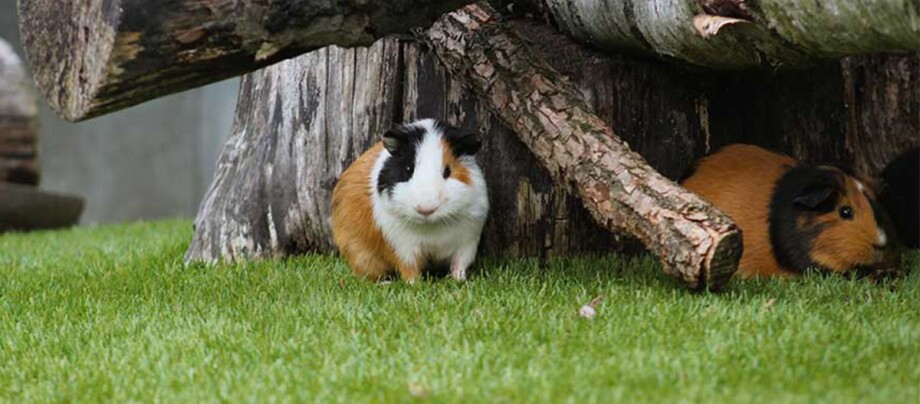
Also, consider vertical space: you might not realize it at first glance, but guinea pigs are skilled climbers that appreciate having sturdy branches, ramps, and other climbing structures.
Guinea pigs are curious creatures that tend to gnaw on everything. If you opt for a wooden enclosure, you must regularly check that all sides remain intact. Their tendency to nibble inquisitively can also pose risks during free-roaming time; electrical cables are particularly vulnerable. Hang all cables as high as possible and secure power outlets—for instance, by placing a board in front of them.
Keeping Guinea Pigs: Indoors or Outdoors?
Guinea pigs live in the Andes, where they are exposed to widely varying temperatures—ranging from freezing conditions in winter to intense sun in summer. Consequently, keeping them outdoors in the garden is perfectly feasible, provided the enclosure is set up appropriately. However, for many guinea pig enthusiasts, this type of housing is not an option. Does this mean you have to forgo keeping guinea pigs indoors? No—you can create a wonderful indoor enclosure that allows them to live a balanced life in a species-appropriate manner.
It is important that the guinea pigs have permanent access to at least half a square meter—ideally a full square meter—per animal, with a minimum total area of three to four square meters. A standard commercial cage measuring 120 × 50 × 60 cm can form part of the enclosure, but it is not sufficient on its own.
Keeping Guinea Pigs Indoors – Here’s How
Whether keeping guinea pigs indoors is successful depends largely on how you set up their cage or enclosure. Ideally, you should provide the minimum required enclosure space across multiple levels. Many owners build these enclosures themselves. With a floor area of 1.5 to 2 square meters per level, you can create a fantastic DIY guinea pig cage within a relatively small footprint. Ensure the animals cannot fall from one level to another by staggering the placement of the access ramps. Distribute several small-animal houses—each with at least two entrances—as well as tunnels and tubes throughout the enclosure. There must be at least as many hiding spots as there are guinea pigs. Depending on the size of the enclosure, daily free-roaming time is also part of optimal guinea pig care. Let the animals zoom around the living room once or twice a day. Just make sure they don’t crawl under sofas or cabinets, as coaxing them back out can be difficult.
Keeping guinea pigs outdoors is possible all year round
If you have a secure garden of sufficient size, you can set up an enclosure there for your guinea pigs that includes a large, permanent outdoor run. As long as their sleeping shelter is well-protected against wind, rain, and frost, there is no reason why they cannot stay outdoors year-round. In cold winter weather, they will huddle close together to keep each other warm. It is important that the shelter is well-insulated; this keeps the cold out in winter and the heat out in summer, ensuring an optimal indoor climate for the guinea pigs.
Caution: Some long-haired breeds are not suitable for outdoor living, as their long fur can easily become dirty or wet. Also, keep in mind that keeping animals outdoors exposes them to various predators. The enclosure must be well-secured against potential threats such as foxes, martens, or birds of prey.
To achieve this, install a barrier against burrowing animals by extending the fence mesh into the ground and angling it slightly outwards. Extending the fence about 50 centimeters underground is recommended to provide genuine protection against digging predators. The top of the run must also be secured with netting, wire mesh, or a roof.
The best of both worlds: indoors and outdoors
Is a large outdoor enclosure too risky or does it take up too much space? Many owners therefore opt for a setup that combines indoor and outdoor living. The animals spend the winter in a spacious indoor enclosure, with additional room to roam in the living area or another suitable room. In summer, they move—either fully or partially—into the garden. If they are to spend time outdoors only during the day, you can set up a temporary enclosure. Part of it must always be shaded. Remember to account for the sun’s movement and ensure there is plenty of fresh water, especially if you leave the house for an extended period. If the guinea pigs are to spend the entire summer outdoors, you will need a high-quality, secure hutch and a suitable outdoor run.
Outfitting an outdoor enclosure for keeping guinea pigs
Here is a summary of the essentials that must be included in your guinea pig’s cage or enclosure:
- Hiding houses: Guinea pigs are prey animals. When threatened, they retreat to their burrows; they also use them to find peace and quiet. Houses and shelters are best made of wood and should have at least two entrances. Small windows look cute, but be careful: they pose a risk of an unwary guinea pig trying to crawl through and getting stuck.
- Stairs, ramps, and branches: These can be made of wood or stone. Stone elements help wear down claws naturally. Ensure that stone stairs, in particular, are sturdy and secure; in their curiosity, guinea pigs are capable of toppling even solid structures.
- Tunnels, tubes, and caves: Guinea pigs love playing hide-and-seek—which is no surprise, given that they live in burrows and tunnels in the wild. Whether using wicker or clay drainage pipes, ensure the diameter is large enough so that no guinea pig can get stuck.
- Water bowl or bottle: Both have their pros and cons. Clay water bowls are easy to clean and are even dishwasher-safe, though they get dirty more easily than drip-feed bottles. If using a bottle, make sure it isn’t hung too high to avoid causing back problems for the guinea pigs.
Further tips on keeping guinea pigs
Please take the time to thoroughly familiarize yourself with a species-appropriate diet for your guinea pigs. Dry guinea pig food alone is far from sufficient. What else do guinea pigs need? Fresh hay, leafy greens, and fresh vegetables are essential. You should also consider how to keep the animals occupied so they don’t get bored in their enclosure. For instance, guinea pigs love rooting out food hidden in various spots; even an empty toilet paper roll is readily accepted as a toy.
Veterinarians advise against using plastic toys or accessories. These curious rodents might gnaw on them and swallow pieces of plastic. Quite a few guinea pigs have fallen ill from chewing on their enclosure furnishings. It is better to use natural materials, such as untreated wood and bark.
Socialising guinea pigs
Guinea pigs do not like being alone; in the wild, they live in groups of up to 20 animals. Anyone who has chosen these sociable rodents as pets knows that keeping a single guinea pig is not an option. But what happens if you want to expand your group, or if one of them dies?
Guinea pigs are highly social animals, so with a little experience and caution, it is possible to introduce new animals to the group later on. However, this is nearly impossible with intact males or older neutered males; even in large outdoor enclosures, such attempts can lead to stress and fighting. Introducing female guinea pigs to one another is considerably easier. It is advisable to let the animals live side-by-side for a few days first, and then give the newcomer time to explore the large enclosure on its own. This allows it to learn where to hide if the others chase it.
Are guinea pigs suitable for children?
Many parents give in to their children’s desire for guinea pigs, which appear so cute. However, guinea pigs are only recommended for children to a limited extent. Small children, who often act impulsively and run noisily toward the cage or enclosure, cause the animals constant stress. Furthermore, they often lack the fine motor skills needed to hold a guinea pig gently without squeezing or even dropping it.
By primary school age, however, children are well capable of looking after guinea pigs themselves—provided they receive the appropriate guidance from you. Through routine care tasks like cleaning the cage and feeding the animals, your children learn to take on responsibility at an early age. What’s more, guinea pigs and children can make great playmates, keeping each other occupied for hours. It is up to parents to teach their children how to treat animals with respect. In the case of guinea pigs, this means they must never be cornered, startled awake, or petted or picked up against their will.
Guinea pigs – the ideal pets?
One final point regarding guinea pig care: Many people believe that guinea pigs enjoy being petted because they sit quietly in a person’s arms or on their lap. This is a misconception. When these small animals are suddenly grabbed and lifted by a human hand, it reminds them of a bird of prey snatching its catch, causing them to freeze in shock. Guinea pigs may look cuddly, but they do not actually enjoy cuddling. It is better to offer a tame animal a small piece of fruit or vegetable and pet it briefly; for them, this amount of human contact is sufficient. Guinea pigs make interesting pets—for observing!