Guinea Pig Behavior: How to Understand Your Guinea Pigs
22.07.2026 - Reading time: 2 minutes

scott / stock.adobe.com
A guinea pig communicates with others of its kind in a variety of ways. It conveys much through vocalizations, while other messages are communicated via expressive body language. By closely observing their behavior and correctly interpreting guinea pig language, you can better understand your rodents.
What your guinea pigs' vocalizations reveal
Guinea pig vocalizations are fascinating and serve as a means of communication among their own kind. However, these charming rodents also communicate with humans—for instance, by squeaking. You are likely familiar with the sound of your guinea pig squeaking insistently, such as when begging for food. A shrill squeak, on the other hand, signals that the animals are frightened, in pain, or generally feeling very unwell.
You should also be familiar with the following sounds your guinea pigs make in order to understand them better and correctly interpret their behavior:
- Chirping: This sound resembles birdsong and is repeated rhythmically. In guinea pig language, it signifies tension or stress.
- Squeaking/Peeping: This high-pitched, quiet, drawn-out sound is the distress call of abandoned young. Older animals sometimes make this sound as well.
- Clucking and murmuring: These sounds signal that your animals are content.
- Grunting: Guinea pigs make a grunting sound when greeting each other in a friendly manner.
- Cooing: Cooing sounds serve to calm the guinea pig itself as well as its companions.
- Teeth chattering: When your rodents chatter their teeth, the sound acts as a warning to other guinea pigs. They also use this noise to try to impress other animals during dominance disputes.
How guinea pigs behave: body language
In addition to vocalizations, guinea pigs—being social, group-living animals—communicate with one another through a varied body language. This body language includes purely physical signals directed at their surroundings, such as rearing up curiously to explore something. It also encompasses body language combined with vocalizations, as seen in the so-called “rumba”—the male’s courtship display toward the female. During this behavior, also known as “rumble-strutting,” the male sways his body from side to side while moving toward the female, emitting humming and cooing sounds. He stands sideways to the female—who is in heat—with his neck fur raised and his head lowered.
Other important body signals are:
- Urine spraying: A female being pestered by a male wards him off with a targeted stream of urine.
- Freezing: If a guinea pig freezes, it is afraid. When these rodents cannot hide or flee from an imminent threat, they fall into a motionless state of fear-induced paralysis, during which their eyes appear to bulge.
- Sniffing: Since guinea pigs recognize each other by scent, they sniff one another’s noses and anal areas to make contact.
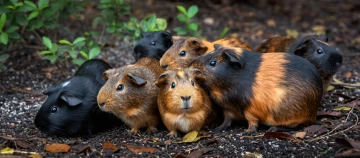
- Cuddling: Young guinea pigs huddle together for warmth and mutual protection. Older animals only display this behavior when frightened or when space is limited in their shelter.
- Leaping/Popcorning: Wild running and leaping seems to be a form of exuberant expression—a “displacement activity” of sorts—that occurs when guinea pigs are happy. This behavior usually happens when the animals are being fed or are playing with one another.
- Yawning: In addition to yawning out of tiredness, guinea pigs also yawn to signal submission. During dominance disputes, a subordinate male yawns to signal that he accepts defeat.
- Licking behind the ear: Guinea pigs show affectionate care by licking their companions behind the ear. This behavior is frequently observed towards sick or fearful animals; older animals often behave this way toward younger guinea pigs as well.
Guinea Pig Behavior: Head-Nudging and Cuddling Often Misinterpreted
Guinea pigs are highly social animals; however, unlike many other rodents, they generally do not groom one another. Nor is the kind of physical contact we call “cuddling” typical behavior for them. Yet many owners—especially children—often want to cuddle or pet their guinea pig, perhaps by picking the animal up or stroking the top of its head. In such situations, a confident animal will signal to its owner that it does not wish to be petted by giving a nudge with its head.
If a guinea pig is held and feels afraid, it will try to make itself as small as possible to present the smallest possible target. When keeping guinea pigs as pets, remember that they do not enjoy cuddling, and respect this natural behavior. Thanks to their complex social nature, guinea pigs are fascinating animals; when properly cared for, they bring great joy and can form a close bond with their human owners, even if they are not “cuddly” pets.